Sales Reframing
Help Buyers See a Situation From a Different Perspective
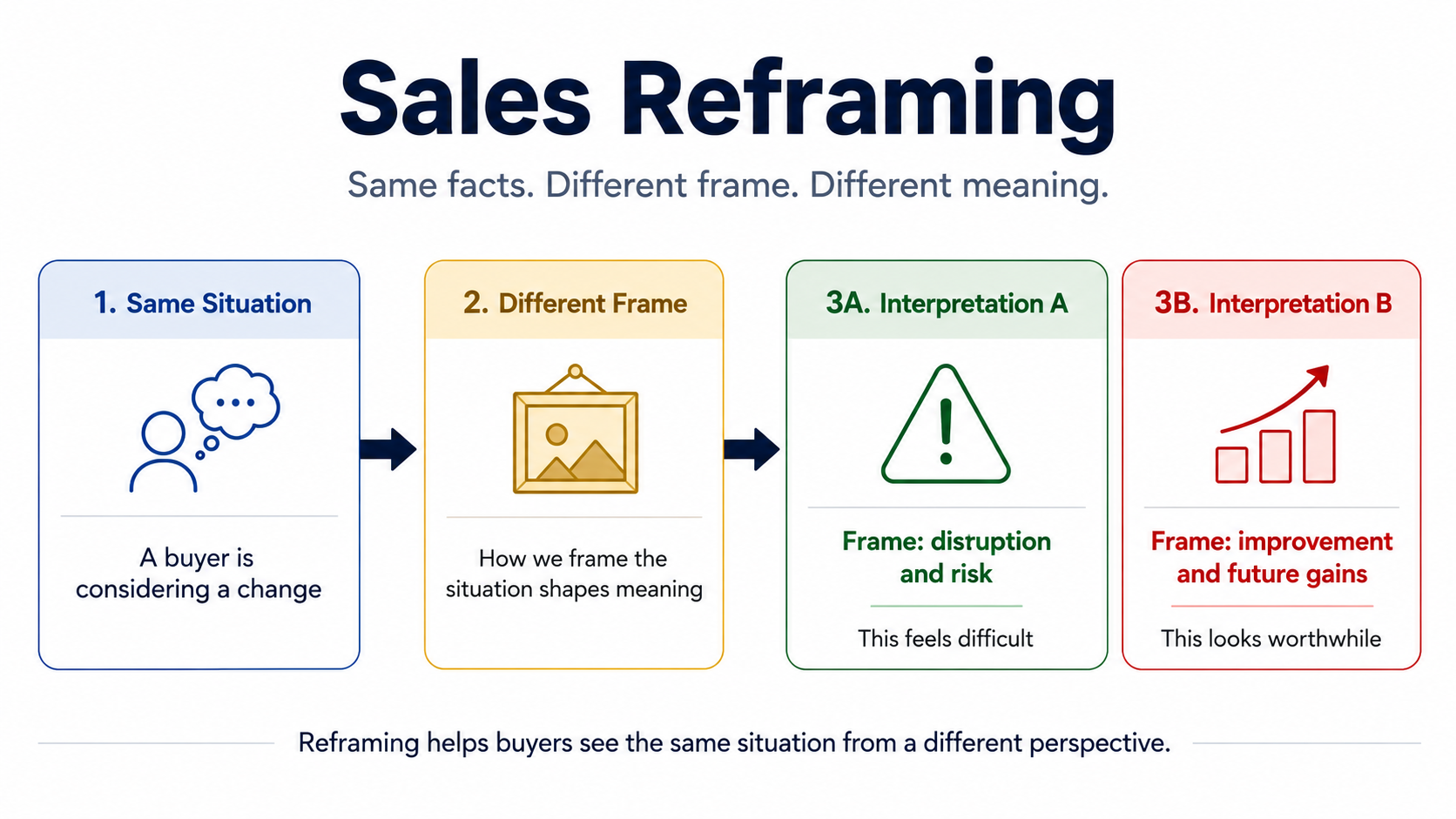
Sales reframing is about changing the way a situation is viewed.
The facts may remain exactly the same, but when you place them in a different context, they can take on a very different meaning.
That matters in sales because buyers don't respond only to facts.
They respond to what those facts mean to them.
A buyer may see a change as risky.
A price increase as a cost.
Implementation as disruption.
Or a new supplier as unnecessary uncertainty.
Sometimes the most useful thing you can do is not argue against that view, but help the buyer look at the same situation from another perspective.
That is reframing.
I'll give you an example of this.
A Personal Example
I recall one night burning the midnight oil with two colleagues, each of us working on separate projects. One of my colleagues piped up with a problem they had.
Colleague: " I'm not really looking forward to contacting the overseas supplier again. This is the third time I've had to modify the order. They are not going to be happy with me !"
Me: " What's the problem ? Are you changing shipping dates or switching product grades or what ?"
Colleague: " No, the client keeps changing the quantities"
Me: " How much have they cut back their order?"
Colleague: " No. They increased their order, again !"
Me: " Wait a minute, that's not bad news !
Surely, the supplier would be happy to learn of an increased order ?
You could even say you've negotiated with the customer to take more to reduce the customers shipping and customs costs.
This would also be more economical for the supplier, wouldn't it ?"
I thus Reframed the scenario for my colleague.
All meaning is context dependent. -- Dr Tad James
What Changed?
Nothing about the situation changed.
The order was still being altered for the third time.
What changed was the meaning attached to it.
My colleague had been looking at the situation through one frame:
“I'm causing the supplier trouble.”
Another frame was equally valid:
“I'm bringing the supplier more business.”
That is the essence of reframing.
We all become locked into particular ways of seeing situations from time to time. Buyers do too.
A buyer might focus on the disruption of changing suppliers without considering the problems that could disappear once the change is made.
They might focus on the purchase price without comparing it with the ongoing cost of the problem.
Or they may see a new approach as risky without considering the risk of doing nothing.
Reframing helps bring those other perspectives into the conversation.
The aim isn't to replace the buyer's viewpoint with yours.
It's to help them see a fuller picture before they decide.
And you know what ?
If my colleague had gone back to this supplier apologetically and expecting an unhappy response, I'll bet that's exactly what they would have received.
This demonstrates something important about frames of reference.
The frame around an issue strongly influences what we notice, how we interpret what we notice, and what meaning we give it.
Different frames direct attention towards different parts of the same situation.
And because interpretation affects how we feel and respond, changing the frame can change the conversation.
Powerful reframing occurs when we reclassify a behaviour, experience or emotion in a way that makes more sense — and leads to more useful thinking, feeling or action.
Experiences become references, and references then operate as our frame-of-references. We then use it to determine how to make meaning of things.
Dr Michael Hall
Preframing
Sometimes you can influence how buyers interpret information by establishing a frame before they receive it.
This is often called preframing.
I used this deliberately when I knew a price increase was coming.
I might tell a customer:
“There is a price rise in the pipeline. I don't have the final figure yet, but based on what I'm hearing I'd allow for something around 10%.”
If the final increase came through at 5%, the customer was often relieved rather than annoyed.
Why?
Because 10% had become the frame of reference.
The customer was no longer comparing the 5% increase with no increase at all. They were comparing it with the possibility of a 10% increase.
That is anchoring in action.
The first figure helps shape how the next figure is perceived.
Preframing can work in many other situations too.
You might prepare a buyer for some short-term disruption before implementation begins. Or establish the current cost of a problem before discussing the price of solving it.
The key is that the frame changes the context in which the buyer evaluates what comes next.
Used responsibly, the frame should still be credible and relevant. It should not be based on something you know to be false simply to make the later information look better.
One of my favourite examples of preframing and contrast is the following letter from a daughter to her parents.
I know of no better example of pre-framing than the letter below.
It is also a very elegant example of the contrast principle.
The Classic Preframe Letter
"Dear Mother and Dad:
Since I left for college I have been remiss in writing and I am sorry for my thoughtlessness in not having written before.
I will bring you up to date now, but before you read on, please sit down.
You are not to read any further unless you are sitting down.
Well, then I am getting along pretty well now.
The skull fracture and the concussion I got when I jumped out the window of my dormitory when it caught on fire shortly after my arrival here is pretty well healed now.
I only spent two weeks in the hospital and now I can see almost normally and only get those sick headaches once a day.
Fortunately, the fire in the dormitory and my jump, was witnessed by an attendant at the gas station near the dorm and he was the one who called the Fire Department and the ambulance.
He also visited me in the hospital and since I had nowhere to live because of the burnt out dormitory, he was kind enough to invite me to share his apartment with him.
It's really a basement room, but it's kind of cute.
He is a very fine boy and we have fallen deeply in love and are planning to get married.
We haven't got the exact date yet, but it will be before my pregnancy begins to show.
Yes, Mother and Dad, I am pregnant.
I know how much you are looking forward to being grandparents and I know you will welcome the baby and give it the same love and devotion and tender care you gave me when I was a child.
The reason for the delay in our marriage is that my boyfriend has a minor infection that prevents us from passing our premarital blood tests and I carelessly caught it from him.
I know that you will welcome him into our family with open arms.
He is kind, and although not well educated, he is ambitious.
Although he is of a different race and religion than ours, I know your often-expressed tolerance will not permit you to be bothered by that.
Now that I have brought you up to date,
I want to tell you that there was no dormitory fire,
I did not have a concussion or skull fracture.
I was not in the hospital,
I am not pregnant,
I am not engaged,
I am not infected,
and there is no boyfriend.
However, I am getting a "D" in American History, and an "F" in Chemistry, and I want you to see those marks in their proper perspective.
Your loving daughter,"
Sales reframing in indeed a valuable skill and can allow you to easily respond to any objection.
For another perspective on reframing, see this explanation from Changing Minds. Go to reframing
You might like these
- Contrast to Sell — how comparison changes the way buyers judge value, price and alternatives.
- Language of Persuasion -- How adapting to the buyer’s language, giving reasons, and using tense and future pacing can influence how ideas are understood.
- Anchoring in Sales — how an initial reference point can influence how later information is perceived.
- How You Say It in Sales — how tone, emphasis and delivery can change the meaning of the words you use.
- Power Words -- How specific words and presuppositional patterns can direct attention and shape assumptions.
- Don’t Say This When Selling -- Common sales phrases that can create resistance — and better ways to phrase them.
- Good Transition Statements for Sales — practical ways to move naturally from one part of a sales conversation to another.
- Sales Language and Framing — return to the main hub for more on how language shapes buyer understanding and interpretation.
- Buyer-Responsive Selling — the broader approach: understand how the buyer is thinking, create clarity and reduce uncertainty rather than relying on pressure or fixed scripts.
- Home
- Sales Language & Framing
- Sales Reframing