Power Words
Words can do more than simply convey information.
Some words subtly influence what the listener pays attention to, what they assume, and how they mentally process what you are saying.
That is what I mean by power words.
Rudyard Kipling once said:
“Words are the most powerful drug used by mankind.”
Perhaps that overstates things a little.
But in selling, small changes in wording can certainly change the direction of a conversation.
I'd like to discuss some power words you can use during the selling process.
The MOST Powerful Word
Before we get into the more unusual examples, there is one word that probably deserves first place:
YOU.
You should usually be using you more often than I in a sales conversation.
Why?
Because the conversation should be centred on the buyer — their situation, their needs and what matters to them.
But there is another group of words that can be particularly interesting.
Words such as: naturally, easily, before, after, realise, experience, because, now can alter the assumptions carried inside a sentence or direct attention towards a particular part of an idea.
Used carefully, they can make your language more precise and more persuasive.
Used badly, they can sound artificial or manipulative.
The real skill is understanding what these words imply and then using them naturally when they genuinely fit the conversation.
What I'm about to offer is a linguistic pattern that uses power words and focuses your client's mind where you want it to focus and just about forces them to accept your concepts and ideas as true. Now, STOP ….. and just image how useful it would be if you could easily do that.
POWER Words
The Power Words are :
- Naturally
- Easily
- Unlimited
- Aware
- Realise
- Experience
- Before
- During
- After
- Among
- Expand
- Beyond
- And
- As
- Causes
- Because
- Now
- Stop
Now you may be thinking what's so special about these power words ?
Well, they become much more powerful if you follow the rule two headlines below.
(Truthfully, the words above are only examples of power words and I have produced this abridged list merely to help you focus on the learning task at hand, i.e. how to incorporate these words into your sales language.
Once you have done that you'll find that you just naturally start to use other similar words in your speech.
How Power Words Work
These words become powerful because of the way they are used inside a sentence.
Some of them can create presuppositions — assumptions that are built into the wording.
For example:
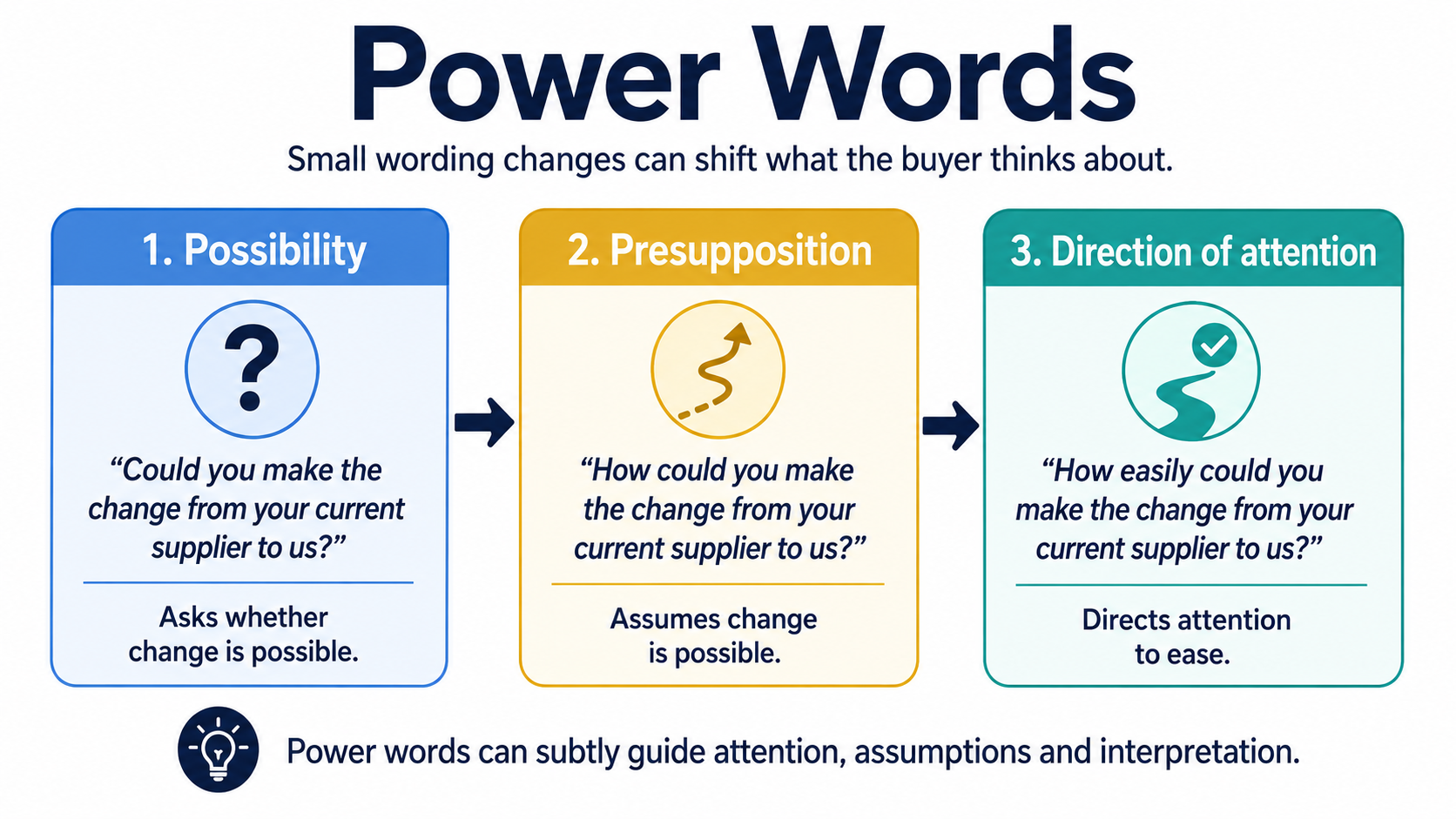
“How easily could you make the change from your current supplier to us?”
Notice what the question does.
It does not ask:
“Could you change suppliers?”
The possibility of changing suppliers is already embedded in the question.
Instead, the buyer’s attention is directed towards how easily the change could be made.
That is a presupposition.
The same thing can happen with words such as before, during, after, realise, experience and because.
They can influence what part of an idea the listener considers and what assumptions sit quietly underneath the sentence.
The Rule: Where You Put the Word Matters
In many cases, the position of the word changes its effect.
Adverbs such as easily or naturally often become more useful when they come before the action you want the buyer to consider.
For example:
“How easily could your team introduce this?”
rather than:
“Could your team introduce this easily?”
The first version places easily in the buyer’s mind before they consider the action itself.
Similarly, adjectives placed before a noun can influence the frame through which the noun is considered.
Compare:
“the change”
with:
“the straightforward change”
or:
“the implementation”
with:
“the gradual implementation.”
Again, the words do not determine what the buyer thinks.
But they can influence what the buyer pays attention to while thinking about it.
That is why these small language choices can matter.
Examples
So let me go straight into some examples of how to use these power words to sell.
Have you ever found yourself saying ?
"Could you make the change from your current supplier to us?"
Well, that is just a question and your prospect could just as easily say
"No ! I can't."
What about,
"How could you make the change from your current supplier to us ?"
Now, that is focusing your client on what you want them to be thinking about
(i.e. how they could change to using your product or service)
but you're leaving a door open for them to say that they don't know how.
What about the sentence below ?
"How easily could you make the change from your current supplier to us ?"
Now where is your customer's mind focused ?
Not on whether they could make the change, nor on how they could do it, but on how easy it could be.
They could still say, "it would not be very easy", but notice that they are still likely to use the word "easy" and the implication is that it's possible.
Also, notice that I did not say,
"How could you make the change from your current supplier to us easily?"
Because, the first thing that would enter your client's mind is how they could make the change and they would already be considering the answer to this question before they ever heard the word easily (if they heard it at all).
It's subtle and it has a profound effect.
Complex Examples
Let me give you some more examples of sentences using these power words.
"Have you discovered how easily you could make a consistent product if you used our improved raw material?"
"Naturally, you'll find more than enough reasons to go ahead today even if you can only see a few of the unlimited benefits that our product provides."
These power words become even more powerful when you stack them into a sentence.
The more of these words you use in a sentence the harder it is for your prospect's conscious mind to filter out the inferences these words are forcing them to make.
"Once you begin to easily absorb this information, you'll naturally discover the unlimited potential it has for readily making your communication infinitely more effective."
(Perhaps this sentences is a bit over-the-top?)
"Have you become aware yet of the many ways that our product could help in your production ?"
(the inference being there are many benefits and you will become aware of them at some point in time.)
"After you experience our product , by trailing it in your plant, you will realise the many ways in which it will easily improve your end product.
More Examples
Here's some more examples using power words.
"Naturally, as you start to realise the unlimited ways you can easily become aware of how using our product will help you to rapidly and effectively accomplish your goals, you'll start imagining the success you can really achieve with our help" (Phew !)
And this is probably over the top.
Technically, I’ve packed a lot of power words into the sentence. Practically, nobody talks like this.
These patterns work best when the language sounds natural. One well-placed presupposition is usually more effective than six of them fighting for attention.
"After you use our product you'll understand it's many benefits"
(the inferences being that they will use the product and it has more than one benefit.)
"Before you decide which of the many benefits that our product offers is the most important to you let me tell you a few things that might help."
(The inferences are that they will decide on a benefit that is important to them and that our product offers many benefits.)
"During the first few months of experiencing our service you'll likely become more aware of the many ways in which we offer substantially more than our competitors."
(The inference being that they will use the service and it is more than a little better than the competitors in a number of ways.)
Before I go any further how much of this have you grasped, so far ?
Can you see how using power words will naturally make your communication more vital and alive and can you guess how much more effective your communication will become once you have mastered the use of these words.
Does this sound like something you need to practice ?
“Among the benefits we’ve discussed, which ones are you starting to realise would make the biggest benefit to you?”
I already discussed the power of the word "because" another article on this site.
The word "cause" can function much like "because" in many situations.
Along with "As" and "And " they are example of "cause and effect statements".
Here are some examples.
"Simply making that statement causes you to understand why you already don't believe it." (every time they make that statement they'll doubt it.)
"As you start to assimilate the information we have provided you will begin to recognise the many ways that our product can help in your process."
The last two power words on our list "Now " and "Stop" are really commands that can be used to great effect.
These words work better if you speak them louder and in a deeper voice tone.
It also helps to actually stop speaking when you utter the word "Stop".
Like below. (emphasise the words in bold)
"You may be considering the effort you need to switch to our product. May I suggest that you just STOP…………….. NOW consider the many advantages our product will easily bring to your production process and all the positive effects that will have on your bottom line."
"We've been back and forth a lot with this agreement and perhaps it's time-- NOW – to consider how we can most easily finalise this deal to our mutual benefit. Now, that seems reasonable, doesn't it ?"
Once you incorporate these power words into your sales language and use them for a month you'll be amazed at how much better your sales calls go.
Wrap Up
You may have been wondering where this issue was heading.
How useful these words would be.
And, as you consider just that, you may find yourself just naturally beginning to experience excitement about what the future holds for you as you begin to understand how easily you can incorporate these words into your sales language, allowing you to enhance your sales results and move beyond the past sales limitations you had before you mastered the skill of using language to direct the thinking of your customer.
Now, as the realisation begins to sink in of how easily and rapidly your sales results will improve, that will cause you get excited about practicing the use of the power words. Now…..
Remember that the purpose of power words is not to overpower the buyer. It is to help them consider an idea, explore a possibility or see a decision from a useful perspective.
Used well, these small language patterns can make your sales conversations clearer, more natural and more persuasive.
Happy practicing.
If you want some words that will help you be more persuasive right now grab a copy of my report below and start having more influence.
Explore Sales Language and Framing Further
Language of Persuasion
How sentence structure, phrasing and presuppositions can shape what a buyer notices and considers.
Sales Language and Framing
How the words you choose, the frame you create and the way you deliver your message affect how buyers interpret what you say.
How You Say It in Sales
Why tone, emphasis and delivery can change the meaning and impact of the same words.
Sales Reframing
How changing the frame around an issue can help buyers see the same situation from a different perspective.
Don’t Say This When Selling
Examples of common sales phrases that can create resistance — and better ways to phrase them.
Buyer-Responsive Selling
The broader approach behind these ideas: adapt to how the buyer is thinking, create clarity and reduce uncertainty rather than relying on pressure or fixed scripts.
- Home
- Sales Language & Framing
- Power Words