The Selling Mindset
The Mindset Required for Sales Success
Introduction
Zig Ziglar famously said "Your Attitude Determines Your Altitude".
Never was this more relevant than in selling. How you think affects how you sell.
It influences the questions you ask, how closely you listen and how you react when the buyer hesitates or says no.
It also affects how the prospect experiences you.
If you lack confidence, prospects may hesitate to trust you. If you appear too confident, push too hard or seem determined to make the sale regardless of what the buyer needs, you can come across as salesy.
A true selling mindset is not simply positive thinking.
A true selling mindset is a mental framework built on resilience, empathy, curiosity, and a growth-oriented attitude.
It shifts your focus from merely pushing products to providing genuine value and solving problems for the customer.
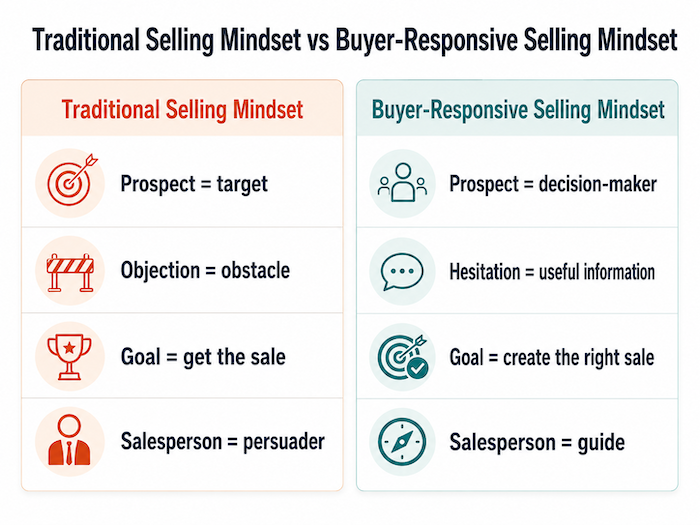
Your Mindset Shapes Your Techniques
You may know how to ask good questions, present value, handle objections and close the sale.
But the mindset behind those techniques affects how you use them.
Are you asking questions to understand your prospect, or merely waiting for something you can use to steer them towards your product?
Are you helping the buyer examine an objection, or simply trying to remove an obstacle standing between you and the sale?
Buyers can often sense the difference.
Your mindset shows up in your voice, your patience and the attention you give to what your prospect is saying.
It determines whether you enter the conversation as a pusher, a product expert or a trusted guide.
How Do You See Your Role?
Some salespeople see their role as convincing prospects to buy.
They believe they must control the conversation, overcome every objection and find the right argument to close the sale.
This creates pressure.
The salesperson feels pressure to perform, and the prospect feels pressure to defend their position.
A more effective selling mindset begins with a different view.
Your role is not to convince everyone.
It is to help the right prospect understand their situation, consider their options and decide whether what you offer is suitable.
You are there to help your prospect think.
You may help them recognise a problem they have underestimated or understand the consequences of doing nothing.
The decision still belongs to them.
This does not mean becoming passive.
When your solution is right for the prospect, explain why and recommend the next step.
But there is a difference between making a clear recommendation and forcing a decision.
A professional salesperson guides the buyer without taking away their freedom to choose.
How Do You See the Buyer?
How you see your prospect is just as important as how you see yourself.
Do you see them as a target, an opportunity or an objection you need to overcome?
Or as a person trying to make a decision that may carry risk and consequences?
Price is rarely the buyer’s only issue.
They may be worried about making the wrong decision, disrupting existing systems or being blamed if the solution does not work.
When you see only resistance, you are likely to push against it.
When you recognise that the buyer may be protecting something important, you become more curious.
Instead of thinking:
“How can I overcome this objection?”
you might ask:
“What is causing the prospect to hesitate?”
Instead of treating doubt as a problem, you can treat it as useful information.
Empathy does not mean agreeing with everything your prospect says.
It means making a genuine effort to understand how the situation appears from their point of view.
When prospects feel understood, they are more likely to speak openly, giving you a better opportunity to discover whether you can genuinely help.
What Is the Sales Conversation For?
A sales conversation is not simply an opportunity to present your product or manoeuvre the prospect towards a predetermined conclusion.
Its purpose is to understand, explore and clarify.
You are trying to understand what the buyer wants, what is preventing them from achieving it and whether your solution provides enough value to justify change.
This requires curiosity and the ability to listen.
When you believe the purpose of the conversation is to understand before you persuade, you use your communication skills differently.
You practise active listening because you are interested in what the prospect means.
You ask open-ended questions because you want the prospect to explain what is important to them in their own words.
What Does a Successful Sales Conversation Look Like?
Many salespeople judge every conversation by one result: Did I get the sale?
Naturally, sales matter. Without them, neither the salesperson nor the business survives.
However, judging every sales conversation by whether you get an order creates a limited, short-term mindset.
It can encourage you to chase unsuitable prospects, ignore warning signs and push for commitments before the buyer is ready.
A successful conversation may result in an order.
But it may also reveal that your solution is not the right fit, clarify what the buyer needs or establish a sensible next step.
Sometimes an honest no is better than a reluctant yes.
Your aim should not merely be to close the sale.
It should be to help create the right sale: one in which the prospect has a genuine need, your solution provides meaningful value and both parties believe the decision makes sense.
This is not soft selling. It is professional selling.
The Limited Mindset Versus the Abundant Mindset
A limited mindset is rooted in scarcity.
Salespeople in this state may see every no as a personal defeat and feel they must close every prospect.
This can lead to trying to sell to everyone, talking too much, discounting too quickly or pursuing opportunities when there is no genuine fit.
An abundant mindset allows you to believe that other opportunities exist.
You no longer need to cling to every prospect.
Your ability to adopt an abundant mindset is often tied to your personal sense of self worth. If you're struggling with basic needs—such as financial or physical safety—reaching higher levels of self-esteem and peak performance becomes difficult.
Rejection can reveal why a prospect was not a fit or how you could improve your approach.
It also gives you the confidence to say:
“Based on what you have told me, I am not certain this is the right solution for you.”
Paradoxically, your willingness to walk away from the wrong sale can make the right buyer trust you more.
Fixed Mindset Versus Growth Mindset
A fixed mindset views abilities as set in stone.
A salesperson may think:
“I am just not good at prospecting.”
“I have never been confident asking for the sale.”
“I cannot deal with difficult buyers.”
A growth mindset recognises that skills improve through practice, feedback and hard work.
You may not be good at something yet. That does not mean you cannot improve.
This adaptability is crucial because buyers, technology and the way people make decisions continue to change.
A growth mindset allows you to examine a poor result without treating it as a judgment of your worth.
You can ask:
- What worked?
- What did I miss?
- What might the prospect have been concerned about?
- What will I do differently next time?
This is how rejection becomes information rather than injury.
You can explore how expectations and beliefs influence your actions in more detail on my Beliefs and Sales page.
Practical Steps to Shift Your Selling Mindset
Notice the assumptions you bring into the conversation.
Before an important meeting, ask yourself what you already believe about the prospect, the opportunity and the likely outcome. Are those beliefs helping you remain curious, or causing you to make assumptions?
Change your objective.
Instead of entering the conversation thinking, “I must close this sale,” choose a more useful objective: understand the buyer’s situation, determine whether there is a genuine fit and agree on the right next step.
Separate rejection from your self-worth.
A no does not always mean you performed badly. The buyer may lack the need, urgency, authority, confidence or resources to proceed. Learn what you can without turning every result into a judgment about yourself. Take Your Ego Out of It. Realize that rejection isn't personal. When you make selling about your ego, you rob the world of a solution that someone genuinely needs.
Review the conversation.
Afterwards, ask: What worked? What did I miss? Where did the buyer hesitate? What will I do differently next time? This is how experience becomes improvement.
Selling Is About Helping People Decide
Developing an effective selling mindset requires you to monitor your motivation, beliefs and habits—and remember what selling is for.
Of course, you need to make money.
Your company needs revenue and you deserve to be rewarded for the value you create.
But when money becomes your only focus, the prospect can begin to feel like a means to an end.
By shifting your attention towards helping people, you improve both the way you sell and the way buyers respond to you.
You become less focused on getting something from the prospect and more focused on creating something with them:
- Understanding.
- Clarity.
- Confidence.
- Value.
And, when the fit is right, a decision that benefits both of you.
That is the mindset behind buyer-responsive selling.
Summary
Developing and maintaining an effective selling mindset requires the vigilance to monitor your motivation, your beliefs and your habits.
It requires a daily commitment to excellence and the courage to get out of your own way. By shifting from a focus on money to a higher purpose of helping people, you not only improve your sales figures but also find more fulfilment in your work.
Just imagine learning to drive: if you don't address your limiting beliefs, your subconscious mind is like the instructor with its foot on the dual brake, stopping you from moving forward even as you try to accelerate. Mastering your mindset is how you finally take full control of the vehicle and reach your destination.
- Home
- Sales Thinking
- Selling-mindset