Know, Like, Trust ... Buy
Why Buyers Decide When They Feel Safe (Not When You Try to Close)
You’ve probably heard the phrase know like trust = buy.
It’s often said as if it’s obvious — almost casual.
But in real B2B sales, it explains something far more important:
- Buyers don’t buy because they’re convinced.
- They buy when they feel safe enough to decide.
That’s what know like trust buy is really pointing to — the internal process a buyer goes through before they commit to a decision they’ll later have to justify. You can help a buyer feel safe.
In Buyer-Responsive Selling, trust is not just about whether the buyer likes you.
It is one of the conditions that can help a cautious buyer move from hesitation to decision.
Without trust, clarity does not land, risk feels larger, uncertainty lasts longer, and internal agreement becomes harder to gain.
What “Know, Like, Trust, Buy” Really Means
Let’s strip this back to fundamentals.
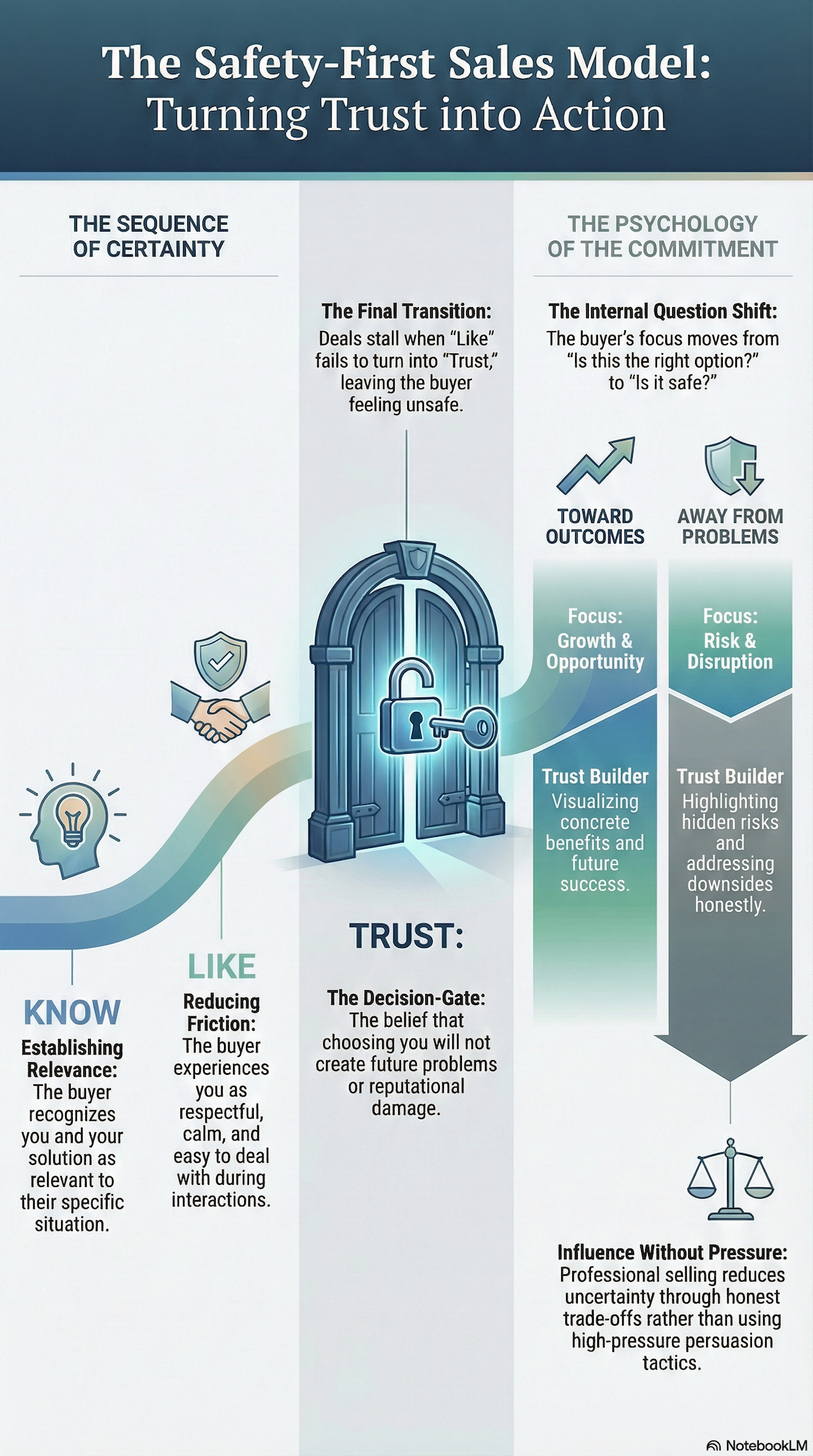
- Know means the buyer recognises who you are and sees you as relevant to their situation.
- Like means they feel comfortable engaging with you and experience you as respectful and easy to deal with.
- Trust means they have sufficient confidence in your competence, your intentions and what you are telling them.
- Buy becomes possible when the buyer has enough confidence in both you and the decision to move forward.
The mistake many salespeople make is assuming these stages happen automatically — or that liking someone leads naturally to buying.
It doesn’t.
Rapport may open the conversation. Trust helps deepen it. But the buyer still has to decide whether the solution, the risk and the change involved make sense for them.
The Know Like Trust Sales Model (Not a Slogan)
Many sales professionals refer to this sequence as the know like trust sales model.
Not as a tactic.
Not as a checklist.
But as a way of understanding how buyers move internally from awareness to decision.
In the know like trust sales model, each step represents a shift in perceived risk:
- From unfamiliar → familiar
- From guarded → open
- From uncertain → safe enough to act
The transition from liking a salesperson to genuinely trusting them is an important one.
But even trust does not guarantee a decision.
The buyer may still be uncertain about the solution, the risks involved, the disruption of change, the views of other stakeholders or whether doing anything at all is worth it.
That is why Know, Like, Trust … Buy is better understood as a decision framework than as a simple sales formula.
Why Buyers Can Know You and Like You — and Still Not Buy
This is one of the most misunderstood parts of selling.
Buyers can:
- enjoy the conversation,
- respect your expertise,
- and still delay indefinitely.
Why?
Because liking someone does not reduce the risks involved in making the decision.
Trust can make those risks easier to examine and discuss.
In the know like trust buy sequence, trust is one important decision-gate.
Until that gate opens, buyers hesitate — often politely, often quietly.
They say things like:
- “Let’s think about it.”
- “Send us some information.”
- “We’ll revisit this later.”
These are not always objections in the usual sense.
Often, they are signs that something has not yet stabilised — trust, clarity, risk, uncertainty, or internal agreement.
How Buyers Experience Risk (The Missing Piece)
To understand know like trust, you need to understand what buyers are protecting.
They’re not just evaluating your solution.
They’re protecting:
- their credibility internally,
- their workload,
- their reputation,
- and their future self if the decision goes wrong.
That helps explain why attempts to persuade can create resistance when sufficient trust has not yet developed.
Pressure — even subtle pressure — can make the buyer feel that their concerns are being pushed aside rather than understood.
Effective persuasion should not force the decision.
It should help the buyer become clearer about the decision, examine the risks and decide whether moving forward makes sense.
Buyer-Responsive Selling recognises that not every buyer needs the same kind of trust-building conversation.
Different Buyers, Different Decision Pressures
One reason the know like trust sales model is so useful is that it helps explain why buyers stall at different points.
Some buyers move toward outcomes
They’re motivated by improvement, growth, and opportunity.
They respond well when:
- progress is visible,
- benefits are concrete,
- and the future looks better than the present.
For these buyers, know like trust accelerates when you clearly articulate what success looks like and how it’s achieved.
Other buyers move away from problems
They’re motivated by avoiding risk, mistakes, or disruption.
They respond when:
- consequences of inaction are clear,
- hidden risks are surfaced calmly,
- and downside is addressed honestly.
For them, trust grows when you help them avoid perceived future pain — not when you oversell upside.
Both styles are rational.
They just respond to different internal filters.
Some people can think both ways.
What matters in a sales conversation is noticing which concerns seem most important to this buyer, in this decision.
How Buyers Prefer to Choose
Another subtle but critical layer of the know like trust buy process is how people like to decide.
Some buyers want a clear path
They feel safer when:
- steps are defined,
- the process is visible,
- and expectations are clear.
Trust builds when you map the journey and explain what happens next.
Others want flexibility
They prefer to:
- keep options open,
- delay commitment,
- and retain room to adjust.
Trust builds when the decision feels reversible and not overly final too soon.
The error is forcing one style on everyone.
The skill is noticing which style you’re dealing with and framing the decision accordingly.
Where Language Shapes Trust
In real sales conversations, how something is said often matters more than what is said.
Language that supports know like trust >> buy:
- acknowledges uncertainty,
- names trade-offs honestly,
- avoids cornering,
- and preserves choice.
Language that undermines it:
- sounds rehearsed,
- rushes certainty,
- or tries to “handle” hesitation.
This is why relying too heavily on scripts can fail.
Persuasion in selling isn’t mechanical.
It’s responsive.
Influence Without Pressure
There are well-known influence principles that explain why persuasion works — reciprocity, authority, consistency, social proof, and others.
They matter.
But they work best when understood as explanations of human behaviour, not tactics to deploy.
I’ve explained those principles here:
On this page, the focus is different.
This page is about how the know like trust model unfolds naturally when buyers feel understood, respected, and safe to decide.
When Buying Finally Happens
At some point, the buyer has to move beyond understanding the option and decide whether they are comfortable acting on it.
The question may shift from:
“Could this be the right solution?”
to something closer to:
“Do I have enough confidence to choose this now?”
That confidence may come from trust in you, confidence in the solution, clarity about the risks, support from other stakeholders and a sense that the change is manageable.
The Know, Like, Trust model helps explain part of that journey.
But the final decision belongs to the buyer.
Not pressure.
Not a clever close.
But enough clarity and confidence to decide.
The Quiet Advantage
Salespeople who truly understand Know, Like, Trust … Buy, don’t need to chase decisions, manufacture urgency or push past hesitation.
They recognise that trust makes an honest buying conversation possible — but it does not make the buyer’s decision for them.
Their role is to help the buyer understand the situation, examine the risks, evaluate the options and become clearer about what makes sense.
Sometimes that leads to a sale.
Sometimes it doesn’t.
But when the buyer does move forward, the decision is more likely to be one they understand and feel comfortable making.
That is very much the thinking behind Buyer-Responsive Selling.
- Home
- Selling in the Post-Trust Era
- Know Like Trust Buy