Don't Say This When Selling
Language That Creates Resistance
Sometimes selling is just about not shooting yourself in the foot.
Over the years, I have seen salespeople damage perfectly good opportunities simply by saying the wrong thing at the wrong time.
Sometimes they talk too much.
Sometimes they ask a lazy question.
Sometimes they say something that makes the buyer defensive, questions their judgement or makes the salesperson sound self-interested.
My first sales manager used to say:
“You have two ears and one mouth. Use them in that proportion.”
It was good advice.
If you ask a question and then watch and listen, buyers will usually tell you whether the conversation is going in the right direction.
A blank stare, a short answer or a sudden loss of interest can be telling you that your language isn't helping.
So here are ten things I would think twice about saying in a sales conversation — and why.
“Tell Me a Bit About Your Business?”
This is one of those questions that sounds harmless.
But in many B2B sales situations, it can make you look unprepared.
If you have had the opportunity to research the company beforehand, the buyer may reasonably wonder:
“Why are you asking me something you could have found out yourself?”
That does not mean you should avoid asking about the business.
It means you should ask a better question.
Instead of:
“Tell me a bit about your business.”
you might say:
“I noticed you have expanded into X over the last couple of years. How has that changed the way you handle Y?”
or:
“From what I can see, you are working across several different markets. Which part of the business is creating the biggest challenge at the moment?”
The difference is important.
The first question asks the buyer to educate you.
The second shows that you have already done some thinking and invites them to explain what matters now.
Good sales questions should not simply fill gaps in your knowledge.
They should help the buyer talk about something useful.
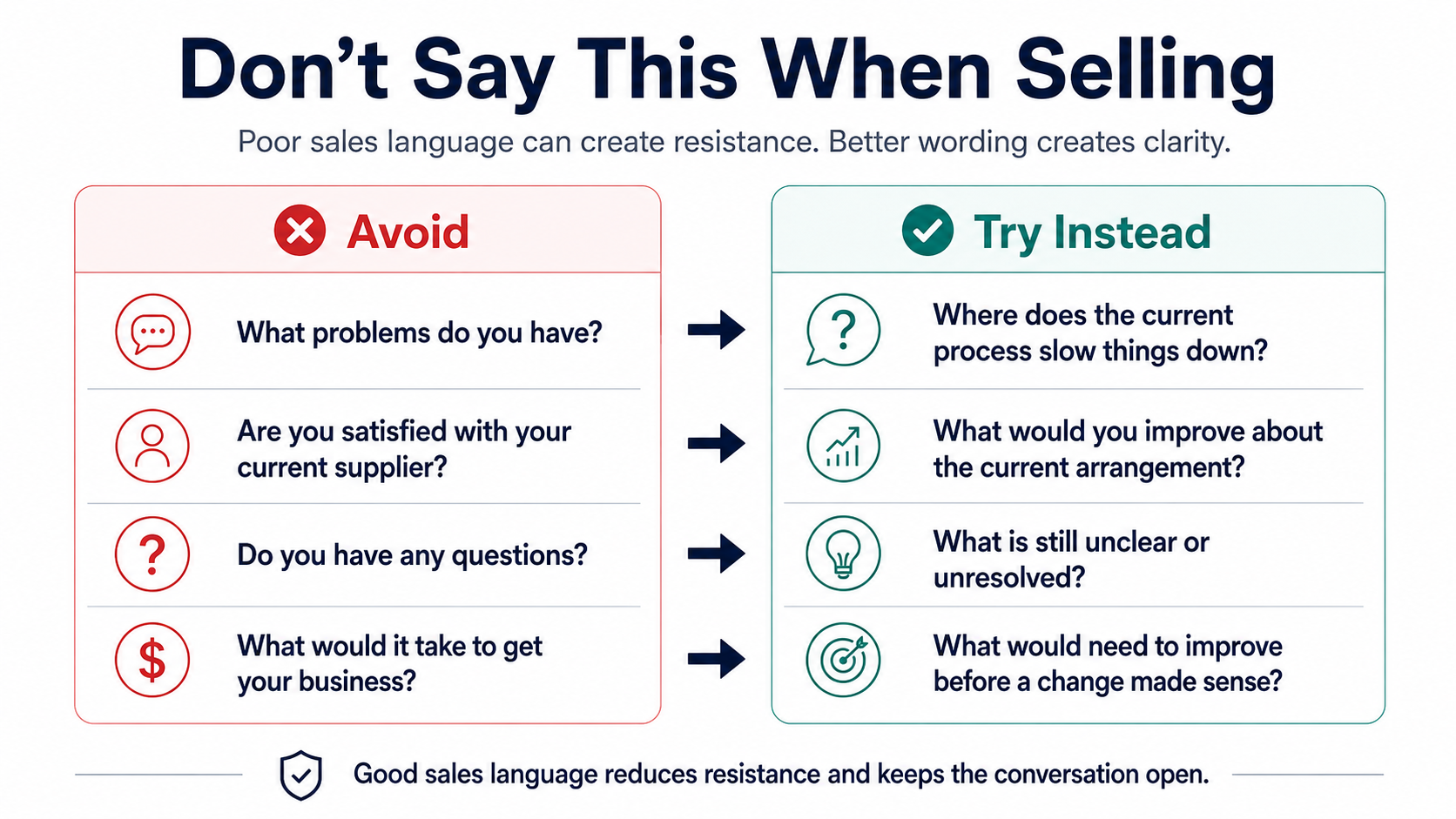
“What Problems Do You Have?”
I have to admit, I asked this question myself in my early days of selling.
And I can't remember many prospects saying:
“I'm glad you asked. Let me tell you all my problems.”
Why?
Because people don't always think of their situation as a problem.
They may see it as an inconvenience, a frustration, something that could work better, or simply the way things have always been done.
And asking directly:
“What problems do you have?”
can feel too blunt — particularly before you have earned the right to ask it.
A better approach is to make the question more specific and easier to answer.
For example:
“Where does the current process tend to slow things down?”
or:
“What part of this gives your team the most frustration?”
or:
“If you could improve one thing about the way this works now, what would it be?”
The aim is still to uncover problems.
But good sales language makes it easier for the buyer to talk about them.
“Are You Satisfied With Your Current Supplier?”
Or
Is everything OK with the company you’re buying from now?
These questions can put the buyer in an awkward position.
If they say yes, the conversation can stop before you've learned very much.
If they say no, they may feel as though they are admitting they made a poor decision in choosing that supplier.
Either way, you have encouraged them to judge their supplier rather than talk about what matters to them.
A better approach is to ask more specific questions about the way things currently work.
For example:
“How quickly can your current supplier normally respond when you need something urgently?”
or:
“What lead time do you usually need to allow for a rush order?”
or:
“If you could improve one thing about the current arrangement, what would it be?”
These questions make it easier for the buyer to talk honestly about the current situation without having to criticise their supplier.
And they give you much more useful information.
The aim is not to persuade the buyer that their existing supplier is bad.
It is to understand where the current arrangement works well — and where there may still be room for improvement.
“I Think This Is the Best Product or Service on the Market.”
You may genuinely believe it. ... But why should the buyer?
You sell the product. Of course you are likely to think highly of it.
Simply telling a prospect:
“I think this is the best product on the market.”
doesn't give them much useful information.
A better approach is to explain why it may be a good fit for their particular situation.
For example:
“Based on what you've told me about the problems you're having with X, this may suit you particularly well because…”
or:
“Where I think this product could help you is…”
The difference is important.
You are no longer asking the buyer to accept your opinion.
You are connecting the strengths of your offer to something the buyer has already told you matters.
And if another product genuinely suits their needs better, saying so can actually strengthen your credibility.
Good sales language is not about claiming your product is the best.
It is about helping the buyer understand whether it is the best fit for them.
“Don’t You Know We Are the Biggest Supplier in the World?” (or in This Market)
I once sat in a joint meeting with an overseas supplier who used almost exactly this line with one of my customers.
He was trying to persuade them to switch from a competitor and buy his product from us (his Australian agent).
The meeting ended very quickly.
As we were leaving the building, the manager pulled me aside and made it very clear that if I ever brought that person back again, not only would he have him removed — he would reconsider the business he was already doing with me.
Why did the comment create such a strong reaction?
Because it wasn't about the customer.
It was about us.
Being the biggest supplier in the world might be impressive, but the buyer is entitled to ask:
“So what does that mean for me?”
If your size gives the buyer better technical support, more secure supply, faster delivery or access to expertise they genuinely need, explain that.
But don't assume that being big, famous or successful automatically makes you relevant.
The buyer does not need to know how important you are.
They need to understand how you can help them.
“We Supply Your Major Competitor With This Product or Service.”
Be very careful with this one.
You may think you are creating credibility by showing that another well-known company already buys from you.
But the buyer may hear something quite different:
“If I buy from you, will you be telling my competitors about me too?”
The business you do with a customer is between you and them.
Unless you have permission to use their name, treating them as a sales reference can damage trust.
And even if confidentiality is not the issue, mentioning a competitor can take the conversation in the wrong direction.
The buyer may start thinking:
“If they are getting it, what price are they paying?”
or:
“Why would I want exactly the same thing as my competitor?”
There may be times when relevant customer examples are useful.
But use them carefully.
If you want to provide social proof, it is usually better to talk about the type of problem you have helped solve rather than casually naming another customer.
Credibility is valuable.
But not if you create it by weakening trust.
Let Me Be Perfectly Honest With You.
Were you honest with me when you said that was your best offer?
This phrase is usually meant to reassure the buyer.
But it can easily have the opposite effect.
If you say:
“Let me be perfectly honest with you…”
the buyer may start wondering:
“Why, aren’t you always honest with me! ”
The same problem can occur with phrases such as:
“To tell you the truth…”
or:
“Honestly…”
If what you are saying is true and important, just say it.
You do not need to announce your honesty beforehand.
In sales, credibility is built through the consistency between what you say, what you do and what the buyer experiences.
The less you have to tell people you are being honest, the better.
“Do You Have Any Questions?”
This is another question that sounds perfectly reasonable.
The problem is that it often produces a very unhelpful answer:
“No.”
And that tells you almost nothing.
The buyer may genuinely have no questions.
Or they may have concerns they have not yet put into words.
They may be unsure what they should be asking.
Or they may simply want to avoid extending the conversation.
A better approach is to make the question more specific and easier to answer.
For example:
“What part of this would you like me to explain in more detail?”
or:
“Is there anything about the implementation that you’re still unsure about?”
or:
“What concerns would you want cleared up before you felt comfortable taking the next step?”
These questions give the buyer something more concrete to think about.
They also make it easier for them to raise uncertainty without feeling as though they are challenging you.
The aim is not just to find out whether the buyer has a question.
It is to uncover what may still be unclear, uncertain or unresolved.
“What Do You Look for in a Service?”
This question is better than some of the earlier examples, but it is still very broad.
Ask:
“What do you look for in a service?”
and you may get a predictable answer:
“Good service.”
“Reliability.”
“Competitive pricing.”
The problem is that those words can mean very different things to different buyers and tell you very little.
A better approach is to make the question more specific.
For example:
“When you say reliability is important, what does reliable service look like to you?”
or:
“What normally separates a good supplier from an average one in your business?”
or:
“When service goes wrong, what causes you the most frustration?”
These questions move the conversation beyond vague labels and help you understand what the buyer actually means.
That matters because if you assume that words such as service, quality, reliability or value mean the same thing to you and the buyer, you can easily end up solving the wrong problem.
Good sales questions create clarity around the buyer’s language — not just around your offer.
“What Would It Take to Get Your Business?”
This question can sound direct and commercially sensible.
In fact, I had a colleague who used it quite a bit.
But it often puts the buyer in the position of designing the sale for you.
Ask:
“What would it take to get your business?”
and you may get answers such as:
“A lower price.”
“Better terms.”
“Faster delivery.”
The problem is that these answers may not tell you what really matters.
They may simply tell you what the buyer thinks they should ask for.
A better approach is to explore what would need to be true for a change to make sense.
For example:
“What would need to improve before you would seriously consider changing suppliers?”
or:
“What would make a change worthwhile from your point of view?”
or:
“If you were going to consider another supplier, what would you need to be confident about first?”
These questions shift the conversation away from:
“What concession do I need to make?”
and towards:
“What conditions would make this decision worthwhile for the buyer?”
That usually gives you a much clearer understanding of what really has to change before the buyer is likely to move.
You May Also Like to Read These
- Sales Language and Framing How the words you choose, the frame you create and the way you deliver your message affect how buyers interpret what you say.
- Sales Questions That Create Clarity - How better questions help you uncover what buyers really mean, what matters to them and what may still be unresolved.
- Good Transition Statements for Sales - Practical ways to move naturally from one part of a sales conversation to the next without sounding abrupt or pushy.
- How You Say It in Sales - Why tone, emphasis and delivery can change the meaning and impact of the exact same words.
- Language of Persuasion - How adapting to the buyer’s language, giving reasons, and using tense and future pacing can influence how ideas are understood.
- Power Words - How specific words and presuppositional patterns can direct attention and shape assumptions.
- Sales Reframing - How changing the frame around an issue can help buyers see the same situation from a different perspective.
- Buyer-Responsive Selling - The broader approach behind these ideas — understand how the buyer is thinking, create clarity and reduce uncertainty rather than relying on pressure or fixed scripts.
- Home
- Sales Language & Framing
- Don't Say This