Be Do Have in Sales
Why who you become matters before what you do
Most sales training starts in the same place.
It teaches you what to do.
A collection of “how-tos” covering prospecting, asking questions, presenting, handling objections and closing.
And of course, those skills matter.
But before you can consistently do the right things in a sales conversation, there is a more important question:
Who are you being in that conversation?
That is where the old idea of Be-Do-Have becomes very relevant to modern selling.
Zig Ziglar once said:
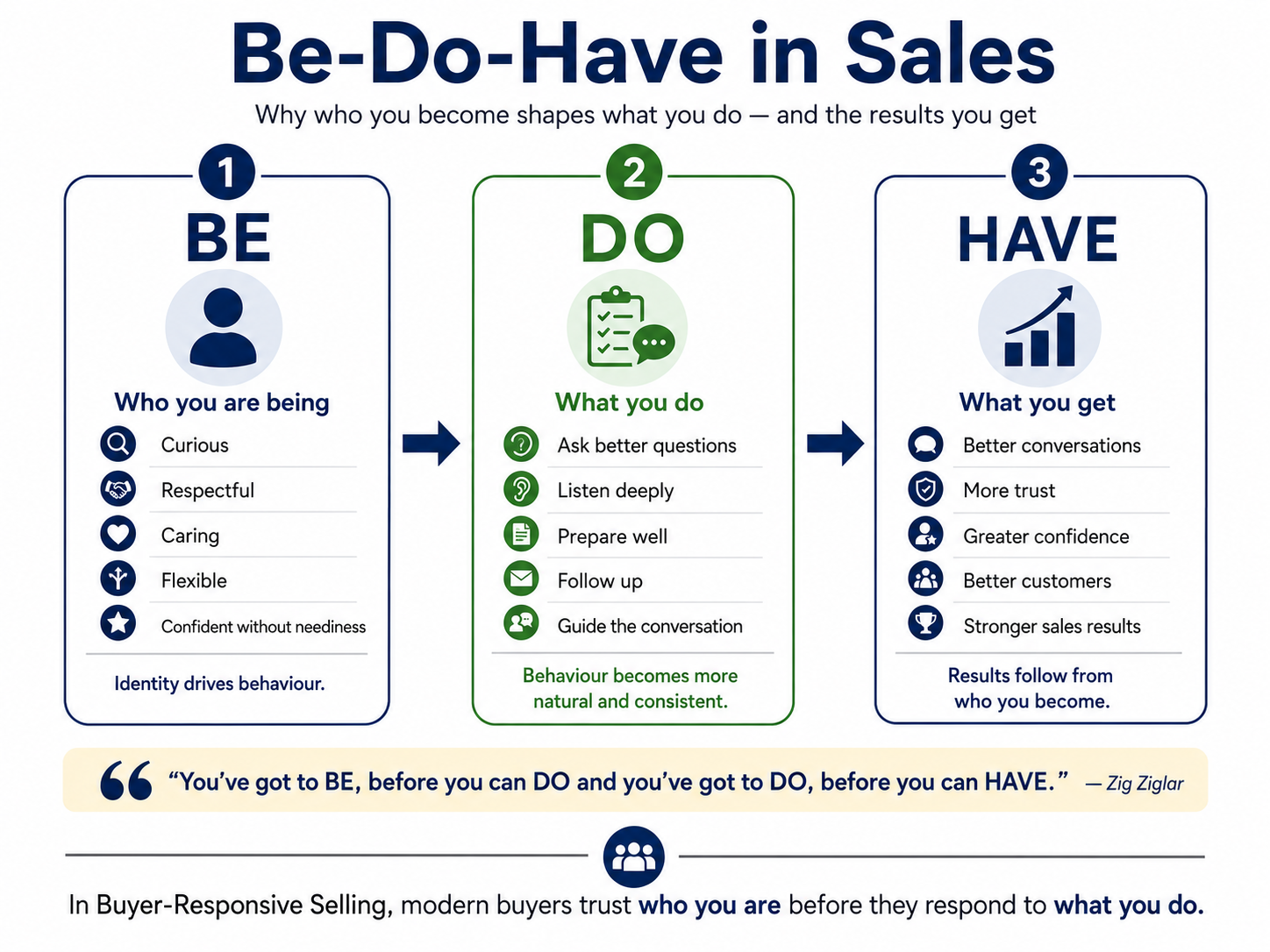
“You’ve got to BE, before you can DO and you’ve got to DO, before you can HAVE.”
That line contains one of the missing steps in a lot of sales training.
Most salespeople want to have better results.
They want to have more sales, bigger commissions, better customers, greater confidence, and more consistent conversations.
So they look for something new to do.
A new:
- script
- technique
- closing method
- objection response
- prospecting tool
And sometimes those things help.
But often the results do not last.
Because the salesperson has changed the behaviour without changing the identity behind the behaviour.
For the change to last the new identity has to be real.
You cannot simply tell yourself that you are a curious, disciplined or buyer-focused salesperson while continuing to think and behave in the old way.
The identity develops as you repeatedly act in accordance with it—until the behaviour no longer feels like something you are forcing yourself to do.
Remember the order matters.
First you become the kind of salesperson capable of producing the behaviour.
Then you do the things that person would naturally and consistently do.
Only then are you more likely to have the results you want.
The Be-Do-Have model shows how identity shapes behaviour—and how repeated behaviour eventually shapes results.
The Be-Do-Have model shows why the salesperson’s identity shapes their behaviour —
and why behaviour eventually shapes results.
Identity drives behaviour
Think about a non-smoker.
A non-smoker does not wake up every morning and decide not to smoke.
They don't need willpower or motivation or a reminder on their phone.
They simply do not smoke because it is not who they are. It's their Identity
And identity drives behaviour.
The same thing happens in sales.
The best salespeople do not have to continually force themselves to listen, remain curious, prepare properly or follow up.
They become:
- listeners.
- people who genuinely curious about the buyer;
- people who prepare thoroughly;
- people who follow up consistently.
That is very different from simply remembering a technique.
What Kind of Salesperson Are You Being?
Years ago, when I was writing about sales success, I listed several attitudes I believed a salesperson should carry into a meeting.
Looking back, I would still stand by them.
A good salesperson needs:
- curiosity
- genuine interest in the buyer
- caring
- respectfulness
- flexibility
- confidence without neediness
These are not just desirable personality traits.
They are part of your broader selling mindset, and they affect the whole sales conversation.
A curious salesperson asks better questions.
A respectful salesperson creates less resistance.
A flexible salesperson can adapt to the buyer’s thinking.
A caring salesperson listens for what is genuinely right for the customer.
A non-needy salesperson does not create the same pressure as someone who is desperate to close.
These qualities shape the buyer’s experience of you.
And that experience affects whether they trust you enough to open up, think honestly, and consider your guidance.
Curiosity is not just a technique
Take curiosity, for example.
A lot of salespeople think curiosity means remembering to ask questions.
But curiosity is more than a questioning technique.
Curiosity is an attitude.
It is a genuine interest in how the buyer thinks, what they are trying to achieve, how their business works, and what matters to them.
When I was selling industrial products, I was often fascinated by how my customers manufactured their products.
I would ask questions about their processes, their markets, their challenges, and the way their business worked.
I did not ask because I was working through a sales checklist. I asked because I was genuinely interested.
That genuine interest helped me earn their respect and trust.
Over time, curiosity became part of who I was as a salesperson.
I did not have to remind myself to be curious.
I had become the sort of salesperson who was curious.
That is the difference between behaviour and identity.
Be-Do-Have and Buyer-Responsive Selling
Buyer-Responsive Selling is not just a set of techniques. It is a way of showing up in the sales conversation.
Modern buyers are cautious, skeptical, and often overloaded with information. They do not need another salesperson trying to push them through a process.
They need someone who can help them examine the decision without adding more pressure.
That begins with who you are being in the conversation.
Are you being:
- curious?
- calm?
- useful?
- respectful?
- flexible?
Are you becoming the kind of salesperson who helps the buyer gain clarity and confidence?
Because the buyer will feel the difference.
If you show up as someone trying to force the sale forward, the buyer may well go on the defensive.
If you show up as someone genuinely trying to understand and guide the decision, the conversation changes.
Before you can guide the buyer’s decision, you need to become the kind of salesperson the buyer can trust with that role.
How to Apply Be-Do-Have in Sales
Begin with the result you want to have.
Perhaps you want stronger customer relationships, more productive conversations or more consistent sales.
Then ask what you would need to do to create that result. You might need to listen more carefully, prepare more thoroughly, ask better questions or follow up more consistently.
Finally, ask who you need to become for those behaviours to feel natural rather than forced.
Do you need to become more curious? More disciplined? More comfortable with silence? Less dependent on getting an immediate yes?
This turns Be-Do-Have from an interesting idea into a practical way of improving how you sell.
The question to ask yourself
So here is the question:
What kind of salesperson are you becoming?
Not just:
“What technique am I learning?”
or
“What script am I using?”
or
“How do I close more sales?”
But:
“Who am I becoming in the eyes of the buyer?”
Am I becoming easier to trust and talk to?
More useful to think with?
More capable of creating clarity and reducing pressure?
More able to help the buyer make a decision they can believe in?
If Zig Ziglar was right—and I believe he was—you must first be.
Then you do.
And through consistently doing the right things, you are more likely to have the results you want.
In modern selling, that begins by becoming the kind of salesperson cautious buyers are willing to trust.
- Home
- Sales Thinking
- Be Do Have