SPIN Selling:
Stop Fumbling & Start Making Sales
Background
- Home
- Sales Book Summaries
- SPIN Selling
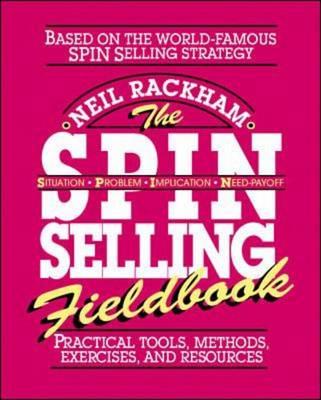
SPIN Selling, a great model, was the brainchild of Neil Rackham who authored a book of the same name in 1988.
SPIN Selling is based on extensive research by Rackham and his company, Huthwaite. They examined large, complicated sales scenarios. After analysing more than 35,000 sales calls they were able to put to rest a variety of traditional myths about closing sales.
The book has been very successful selling over 150,000 copies.
The original survey showed that in successful sales calls it's the buyer who does most of the talking, which means that the salespeople are asking questions.
Asking questions means that the salesperson is building Rapport with the buyer, building sales rapport with the buyer allows the buyer to feel more comfortable talking.
SPIN Selling proposes there are four types of questions, thus SPIN stands for :
- Situation ( questions )
- Problem ( questions )
- Implication ( questions )
- Need-payoff ( questions )
Types of Questions
Situation Questions deal with the facts about the buyers existing situation.
Problem Questions ask about the buyer's pain and focus the buyer on this pain while clarifying the problem, before asking implication questions. . These give Implied Needs.
Implication Questions discuss the effects of the problem, before talking about solutions, and develop the seriousness of the problem to increase the buyer's motivation to change.
Need-Payoff Questions get the buyer to tell you about their Explicit Needs and the benefits your solutions offers, rather than forcing you to explain the benefits to the buyer. Getting the buyer to state the benefits has greater impact while sounding a lot less pushy. What these questions do is probe for explicit needs.
The research uncovered the following facts :
The first students trained in the "SPIN" model showed an average of 17% improvement in sales results.
This is not surprising, I well remember the quote, (but not the author), that says:
People do not buy from salespeople because they understand their products but because they felt the salesperson understood their problems.
Situation Questions - Don't Overuse
The more Situation Questions asked in a sales call the less likely it was to succeed.
Most salespeople asked more Situation Questions.
The more senior the buyer, the less they like answering factual questions.
( I have some issue with this because I feel that the buyers reaction may also depend on the level of sales rapport developed between the seller and the buyer ).
This implies that successful sellers ask fewer Situation Questions because they do their homework. Good selling = good planning.
To quote "SPIN Selling" "…effective planning takes you more than half way to effective execution"
More Problem and Implication Questions
More experienced salespeople tended to ask more problem questions and to ask them sooner.
Top salespeople tended to introduce solutions, products or services very late in the discussion.
They held back and discussed the effects of the problem before talking about solutions.
Problem Questions require planning. SPIN Selling suggests working backwards from the problems your products solves for a buyer to generate these questions.
In Huthwaite's work with Xerox Corporation, they proved that in the absence of follow-up coaching and reinforcement, 87% of the skills change brought about by even the best sales training is lost.
So, it could be wise to invest in sales coaching.
It is better to uncover several problems before asking implication questions. It can be dangerous to focus on one problem as it invites the buyer to raise another area where you solution does not fare so well. (Don't put all your eggs in the one basket)
Implication Questions are the most powerful sales questions and the skill in using them doesn't automatically improve with experience.
There are no perfect solutions in a complex sale.
There is no evidence to establish a link between open questions and sales success.
People buy when the pain of the problem is greater than the cost of the solution.
Opening benefit statements work in smaller sales but much less so than in bigger sales. SPIN Selling strategy would contend that the purpose of the opening is to gain the buyers agreement to ask questions (this is establishing rapport) , to establish a buyer-centered purpose (most important) and communicate who you are and why you are there.
The Difference with Larger Sales
Larger, complex sales are different. Rackham believes that the key is to obtain the right commitment. He defines success versus failure by evaluating the level of commitment. An action that moves you closer to a sale, is termed an Advance and constitutes a successful outcome. A buyer's request for a proposal is not an Advance unless the buyer also agrees to take some action. The outcome of a call that does not reach agreement on action that moves the sale forward is termed a Continuation and considered unsuccessful.
Top sellers reach their goals by consistently planning and conducting calls that move the sale forward in steps. "SPIN Selling" rationale suggests that you start by brainstorming to identify the widest variety of Advances that would move you towards a sale. Really skilled sellers then select those ingenious small actions that the buyer is likely to agree to. They also generate alternative actions to propose as needed for the actual sales visit.
"SPIN Selling" suggests you develop a questioning mindset stating it's "more important to understand than to persuade". This is similar to the 5th habit from "The Seven Habits of Highly Successful People" (by Steven Covey) which says "Seek first to understand then to be understood".
There are safe and dangerous areas ( and times ) to use various question types. ( Once again, the effect of bad timing can be dramatically reduced if you have good sales rapport with your prospect.
It states in "SPIN Selling" that "Asking good questions doesn't come easily for most people"
Stages to a Sale
Furthermore Rackham and Huthwaite contend there are four stages to a sale :
Opening
Investigating
Demonstrating Capability
Obtaining Commitment
And their research shows that the Investigating stage is the most crucial in large, complex sales.
The book also proposes in relation to Demonstrating Capability that you need to sell Benefits rather than Features and Advantages.
In the SPIN model a Benefit shows how a product or service meets an Explicit Need expressed by the buyer. Moreover, the author contends that If you try to sell using Advantages it leads to objections which slow down the sales process.
In my opinion the concepts of "SPIN Selling" are sound and represent a logical and teachable way to move towards a large and complex sale.
The whole focus of the book is on logical objective planning, investigation of the prospects needs and selling the Benefits of your offering ( Benefits which are based on the prospects needs ).
The problem I have with the model is that not all sales are based on logic and objectivity.
At the opening of any sales call you need to develop Rapport with the buyer. Developing Rapport is not a conscious thing. The best rapport is built at an unconscious level.
Likewise, SPIN Selling is based on asking questions and there is a very large difference in the effectiveness of a question depending on how it is phrased.
I believe the results generated by the rational, objective approach of the SPIN Selling model could be enhanced by the application of various subconscious selling techniques.
I hope you have enjoyed this brief summary of the SPIN Selling Model.
Learn More
For a more complete
understanding of
SPIN Selling
Click Here
For specific examples of
SPIN Selling
Questions
Click Here
- Home
- Sales Book Summaries
- SPIN Selling